We're Fighting the Wrong Dystopia
Or when will it finally clock to the average lib that the Great Opponent isn't Reagan-era Christian conservatism but the amoral self-indulgent hyperreality that we currently inhabit

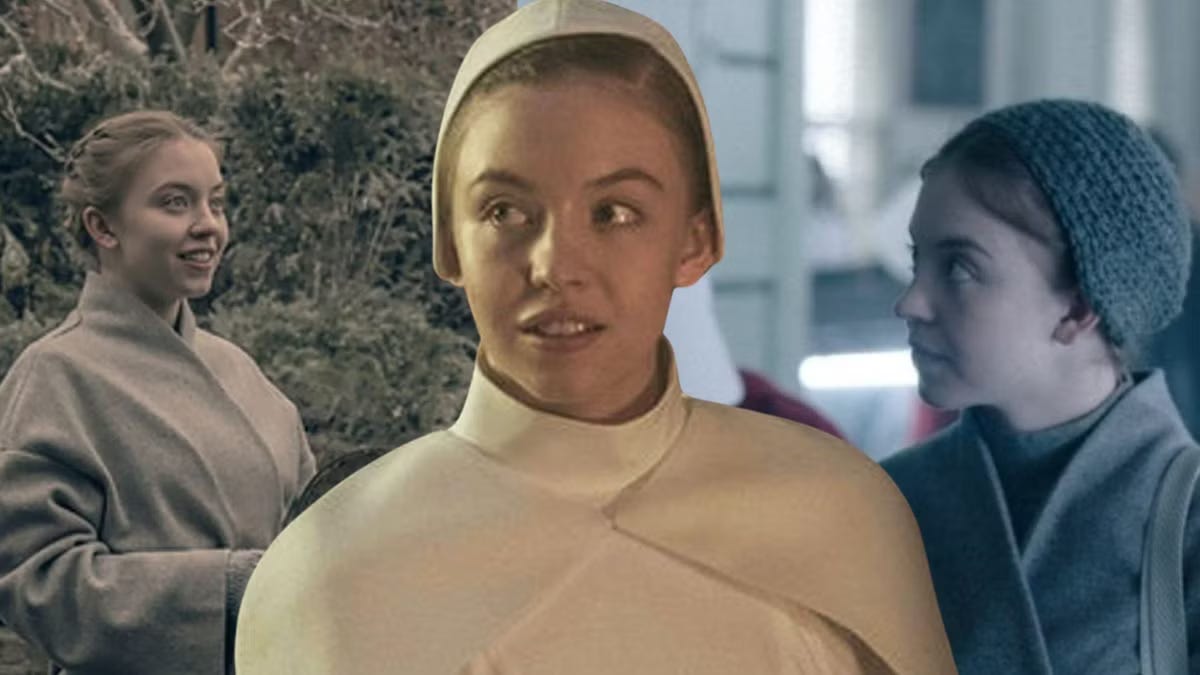
The conservative husbands of this country are wearing fake tits but yet we’re still paranoid about Gilead in The Handmaid’s Tale. Six seasons of the show and what we’ve learned is that the American cultural imagination can only picture oppression when it comes wearing a bonnet and Sydney Sweeney’s bad acting in it.
And now, we’re even getting a sequel series. The show has been renewed, rewarded, and wept over at Park Slope wine nights, it has become less a television show than a load-bearing myth — the bedtime story a particular class of NPR subscribers tells itself about what danger looks like.
Handmaid’s Tale is a dystopia of coherence: the villain believes something, wears robes, follows hierarchy, holds a clipboard you can argue with, quotes scripture you can rebut. Evil has a structure and a recognizable shape. This is, medically speaking, cope. Comfort food for people who need their oppression narratively satisfying.
But the actual enemy we’re fighting right now requires no belief at all and no ideology you can argue against. We are fighting the void — a system organized around nothing except continuation, where meaning arrives in fragments that never add up, where atrocity and entertainment share the same feed with equal weight, where you can watch genocide between ads for probiotics and experience both as equally valid content.
There’s no villain to argue with because there’s no argument being made. Just the endless production of engagement that goes nowhere. This is the threat liberalism cannot name because naming it would implicate everything they’ve built.
Here’s what nobody wants to say plainly: the problem isn’t that we have bad values. It’s that we have torn down the infrastructure required for values to actually matter for the sake of elevating personal choice.
The mechanisms that used to convert individual moral conviction into collective moral fact — the church, the union, the party, the shared narrative, the institution you could trust without performing irony — have all been either discredited or captured.
What replaced them? The market and the algorithm, which are the same entity, and which have exactly one value: continuation. The algorithm doesn’t want you to feel good or bad. It wants you to feel, because feeling generates engagement, and engagement is the only metric the system recognizes.
Outrage performs exactly as well as horniness. Both monetize beautifully. Neither leads anywhere. Neither was designed to. There IS a word for a world organized exclusively around this principle, and it’s not fascism, it’s not theocracy, and Sydney Sweeney’s bonnet has absolutely nothing to do with it.
The Spectacle
A Reddit incel-looking French guy named Guy Debord published The Society of the Spectacle in 1967 and the book is six hundred theses long and reads like a man who is extremely angry about something he cannot quite point to, which is the correct response to the thing he is describing.
His argument is not really about television or advertising as a dinner-party abstraction, though it contains all of those. It is about something more interior and harder to name: the feeling of living in a world where experience keeps arriving already processed. Already captioned. Already understood.
Where nothing quite touches you because everything has been pre-digested into an image of itself before it reaches you, and you consume the image, and you have the feeling of having felt something, and then you scroll.
Debord called this the spectacle, by which he did not mean spectacle in the sense of something dramatic and large. He meant the totality, the accumulated product of a civilization that had learned to replace lived experience with the representation of lived experience so seamlessly that the replacement stopped feeling like loss.
You don’t experience love; you experience situationships that last six months where nobody defines anything and you communicate entirely through memes until someone ghosts. You don’t experience community; you experience Discord servers. You don’t experience politics; you experience the image of political engagement, the protest selfie, the infographic repost, the feeling of being someone who CARES, and the feeling is real, and it goes nowhere, and the system continues.
This isn’t false consciousness in the old Marxist sense where you’re deceived about your material interests. It’s something more total: you’re not deceived. You simply exist in a register where the question of what is real has stopped being answerable or even something people ask anymore.
What Debord was diagnosing was the specific modern experience of nothing cohering and of meaning arriving in fragments that never quite add up. Of being a person in full — feeling things, wanting things, believing, briefly, in things — inside a system that processes all of it as content and returns it to you at a markup.
The content of your life becomes the raw material for the image of your life, which you then consume, which generates more content, which is the whole loop, running forever, and at no point in the loop does anything mean anything in the way that meaning used to mean something, which is: in a way that changes what happens next.
He was writing in 1967. He was describing the specific texture of checking your phone at 2am and feeling nothing and checking it again.
The Left was at the barricades the following year — literal cobblestones, May 1968, Paris, the largest general strike in French history — and Debord watched it and said: this too. The image of revolution replacing revolution. The feeling of resistance substituting for resistance.
Donald Jared Trump
Which brings us, unfortunately, to Trump.
What is interesting about Trump is not that he is bad, which he is, obviously. What is interesting is that he is the first purely amoral political figure — not immoral, which implies a relationship to morality, even if adversarial, but amoral in the clinical sense: morality simply does not parse for him.
He does not believe wrong things. He does not believe things. He performs, and the performance works, and it works because it is perfectly calibrated to an environment that has replaced belief with vibes and consequence with engagement. He is not the disease, but the most legible symptom of an environment in which nothing means anything and the guy who noticed first wins.
He didn’t emerge from the churches or the Heritage Foundation policy wonk infrastructure. He emerged from the New York Post gossip pages, a world where fame and notoriety share a currency and the only sin is being irrelevant.
From Atlantic City casinos that went bankrupt while he collected management fees — the first proof of concept that the brand survives product failure. From The Apprentice, which is, without exaggeration, the most consequential work of political fiction produced in the last fifty years. Fourteen seasons of NBC brainworms taught Middle America he was a competent executive. This was a fiction the network produced, the audience consumed, and the Electoral College eventually ratified. The image of competence replaced competence.
And then the algorithms did what algorithms do: they detected he generated engagement, engagement is the only value the system recognizes, so they fed him to everyone regardless of preference or sanity or whether it would destroy democracy.
By the time Jeb Bush had spent $90 million in super PAC money on what turned out to be a vibes problem, it was over. Trump had the funny takes. In a culture that has elevated entertainment to the primary mode of political experience, the take IS the thing, a fact currently being monetized by approximately every podcast in existence.
The Nihilistic Goonerism of It All
We keep trying to frame this as a political problem because framing it as a civilizational one would require looking in the mirror. We’re fighting about Gilead — the theological dystopia — because the theological dystopia at least implies something matters enough to be worth controlling. An enemy with a Bible has a moral framework, which means morality still exists as a category, which means we’re still in a world where things mean things. We are not in that world anymore. We are in the void.
The nothingness arrived quietly sometime between Web 2.0 and whatever cursed phase of internet brain rot we’re in now, and it made itself at home, and we adjusted the way humans adjust, because adjustment is what we do, and now we live here. We scroll through climate collapse updates between targeted ads for luxury skincare and we feel something — outrage, despair, the specific exhaustion of people who understand what’s happening and cannot stop it but also cannot stop checking — and then we feel nothing, and then we scroll again.
This isn’t apathy because apathy is the absence of feeling. This is more sophisticated: the continuous production of feeling that goes nowhere, was never designed to go anywhere. The system doesn't want you numb. It wants you feeling EVERYTHING, ALL THE TIME, in a way that keeps you engaged but never organized, never focused, never actually threatening to anything.
The only thing that has ever interrupted a spectacle is finding something the spectacle cannot digest — work that won’t photograph, love that resists documentation, grief too private to perform. But here’s the problem: even suggesting this becomes content. Even “log off” is a brand now. The spectacle is so total it can absorb its own critique. I’m writing this, you’re reading it, and we both know nothing will change. The quarterly earnings are strong.
Debord thought the only exit was to refuse the spectacle entirely, to drop out, to build situations instead of consuming images. He dissolved his own movement, moved to the south of France, drank heavily, and eventually shot himself, which is one way to log off permanently.
The rest of us are still here, still scrolling, still feeling the feelings that go nowhere, and someone just paid $8 for a blue checkmark to argue about Gaza more effectively, and the exclusive pickleball club has a waitlist, and somewhere out there Kristi Noem’s husband is in a Victoria’s Secret dressing room trying on a push-up bra and a content creator is filming it and we will have all moved on before you finish reading this sentence.
This is fine. This is fine. Everything is fine.
Stop the train, I’d like to De-bord
genuinely best analysis i've read of "our times"